
Bramble
Invite-only alpha; iOS betaA community platform for real-time messaging, voice channels, and group spaces. I built all of it: the server and WebSocket gateway, the voice system, the mobile, web, and desktop clients, and the infrastructure they run on.
What it does
Communities with text and voice channels, real-time messaging, presence, voice and video calls, and screen share, plus group DMs and calls outside any server. It runs in the browser at bramble.gg, on iPhone, and as desktop apps for Windows, macOS, and Linux, all from one client codebase.
Bramble is in an invite-only alpha while it grows slowly. The iOS app is in public beta on TestFlight, and Android is next.
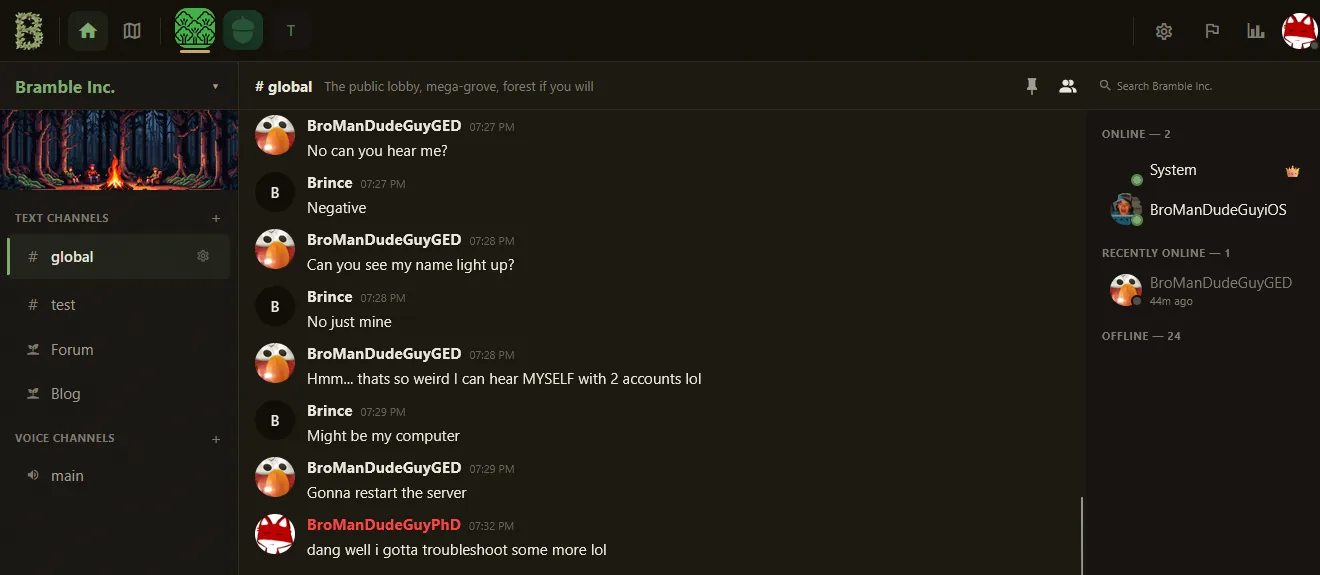
How it’s built and run
- Server
- TypeScript on Node 22 with Fastify 5 and a raw WebSocket gateway. Postgres 16 with hand-written SQL migrations, Redis for presence and the event bus.
- Voice
- WebRTC peer-to-peer for up to four people, moving to a mediasoup SFU for bigger calls and screen share. coturn for TURN.
- Clients
- One Expo / React Native codebase for iOS and web, wrapped in Electron for desktop.
- Hosting
- Production on a Hetzner server behind Cloudflare, with nginx accepting traffic only from Cloudflare. Staging on ironman, a Linux machine I run myself.
- Deploys
- GitHub Actions on self-hosted runners. Each deploy type-checks, lints, migrates, and tests, then swaps blue/green with a health check. The last five releases are kept for rollback. Production has taken 480 deploys since March 2026, a median of six minutes from push to live.
- iOS releases
- fastlane on a self-hosted Apple Silicon runner, straight to TestFlight.
- Monitoring
- Prometheus with 14 alert rules, Grafana dashboards provisioned from the repo, and Sentry on server and client.
- Tests
- Around 900 server tests that run against a real Postgres, including a tenant-isolation suite, and around 1,000 client tests.
- Secrets
- Doppler, with separate production and staging configs.
Engineering notes
-
Zero-downtime deploys with voice in memory
Voice rooms live in process memory, so restarting the server would drop every call. A deploy starts a second instance on its own port and UDP range, checks that its health endpoint really is Bramble (added after another service on the same port passed the old check), switches nginx over in one step, and lets the old instance drain for 60 seconds.
-
Voice that changes shape as calls grow
Small calls stay peer-to-peer. When a fifth person joins or someone shares their screen, the server moves the call to a mediasoup SFU. Room ownership is claimed in Redis, so this keeps working with more than one server instance.
-
A gateway that survives dropped connections
Every event on a session is numbered and the last 500 are kept, so a client that drops for under two minutes resumes exactly where it left off. Clients that read too slowly are cut off before they use up memory, and on shutdown clients reconnect at staggered times instead of all at once.