Canopy
Live on web; beta on iOS and AndroidStaff scheduling and team management for small counseling practices that have outgrown spreadsheets. Client and staff schedules, time off, timesheets, and team messaging in one app on the web, iPhone, and Android.
What it does
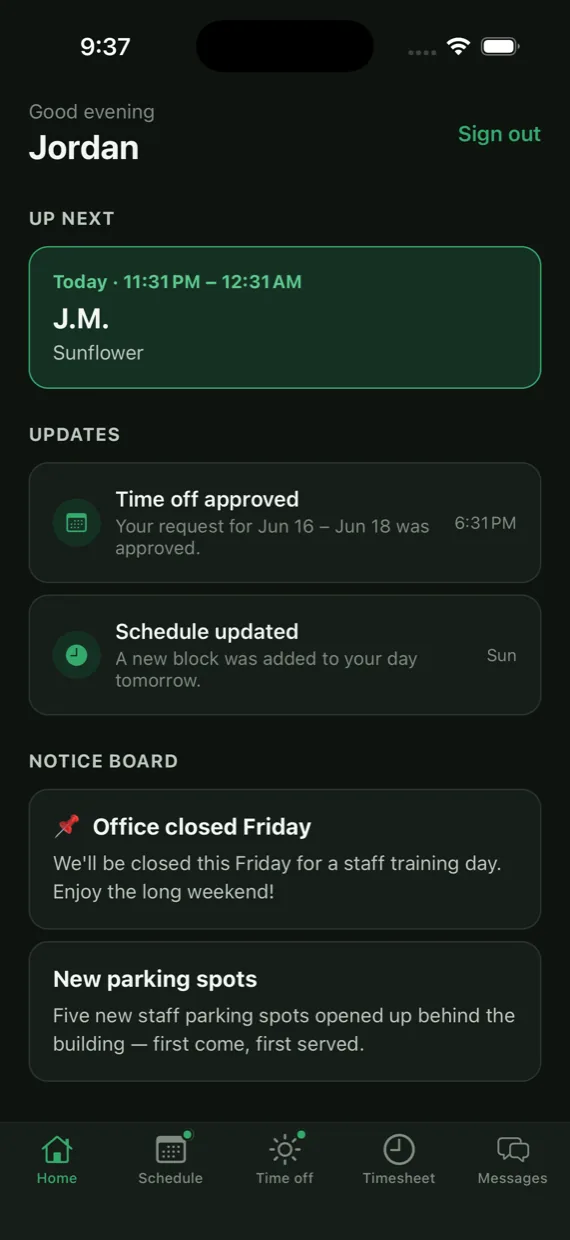
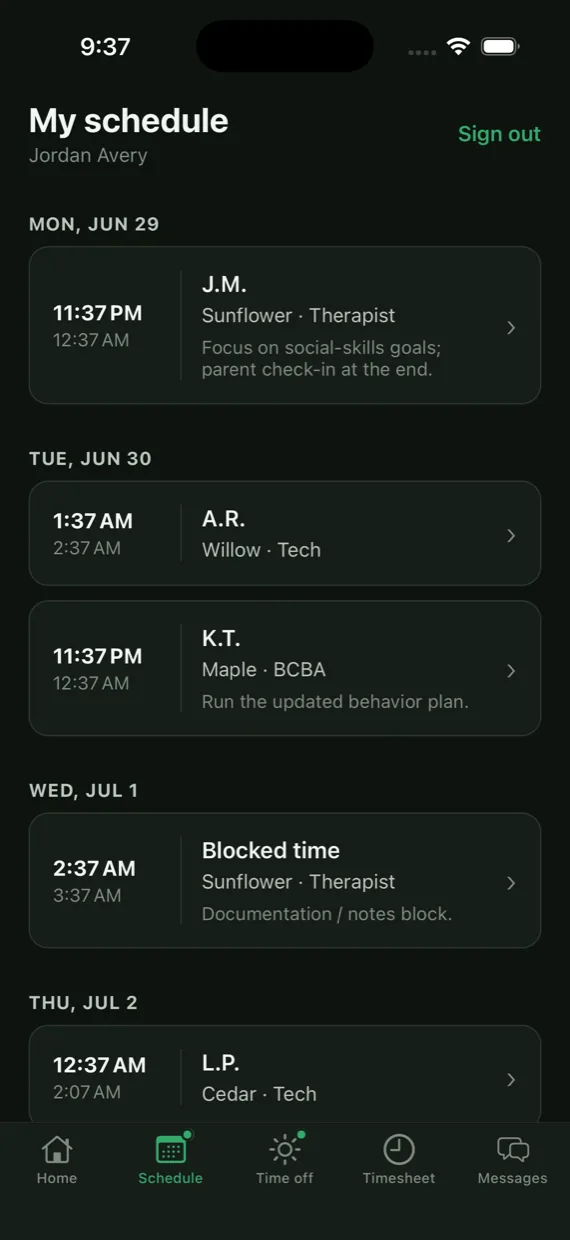
Managers build the week’s schedule, with a generator to draft it, and everyone sees sessions, rooms, and clinicians in one place, with push notifications when something changes. Staff request time off and clock in and out from their phones, and the team talks in direct messages, group channels, and announcements.
Schedules sync two ways with Google Calendar and publish as calendar feeds. Each practice is its own organization with its own settings and branding, and its data is kept separate from every other practice’s. Canopy stores no clinical data: clients appear by initials or nickname only.
Practices sign up on the web with a free 30-day trial and no card. The iPhone and Android apps are in public beta and included with every practice, with no extra seats to buy.
How it’s built and run
- Apps
- A TypeScript monorepo: Next.js 16 and React 19 for the web, Expo and React Native for iOS and Android, and a shared package of domain types.
- Backend
- Self-hosted Supabase: Postgres, auth, Realtime, and Deno edge functions. There is no separate API server; Row Level Security enforces access and keeps each practice’s data separate.
- Hosting
- Single-node k3s with Supabase from its Helm chart, behind Cloudflare. Production runs on a Hetzner server alongside other live services; development runs on ironman, a Linux machine I run myself. Either node can be rebuilt from one script.
- Deploys
- Self-hosted GitHub Actions runners take a deploy lock, rehearse migrations on a copy of the live database, apply them in expand/contract order, run the database tests, then swap blue/green. Every deploy has a manual rollback job. Since production launched at the end of September 2026, it has taken nine deploys of about three minutes each, and the rollback job has been used once, finishing in just over a minute.
- Mobile releases
- iOS archives on a self-hosted Mac and uploads to TestFlight; Android builds locally with EAS and submits to Google Play testing tracks.
- Tests
- About 530 pgTAP assertions covering tenant isolation, privilege escalation, and rate limits, about 700 unit tests, and Playwright end-to-end tests, all in CI.
- Backups
- A nightly in-cluster job dumps Postgres to object-locked offsite storage and keeps 30 days, with a restore rehearsal script.
- Secrets
- Doppler, synced into the cluster by its operator.
Engineering notes
-
Blue/green on a single node with one shared database
Both versions of the app run against the same Postgres during a swap, so every migration has to keep the old version working. A lint enforces expand/contract migrations: additive changes go out before the swap and removals after it. The live service is switched in one atomic patch, and in development a probe hits the site every 0.2 seconds during deploys and fails the run on any non-200.
-
Rehearsing migrations on a copy of the live database
Before touching production, each deploy restores the live database into a scratch copy and runs the pending migrations there. The copy can’t send push notifications or run scheduled jobs, because those extensions only fire in the main database.
-
Moving onto a server that was already in production
Canopy’s production node shares its Hetzner server with other live services. The bootstrap runs a regression check against those services after every step, binds cluster ports to localhost, reserves memory for its neighbors, and writes its own self-contained nginx config so it can’t break theirs.